Wednesday, April 23, 2008

High Decani Monastery

One of the jewels of the Serbian medieval civilization, the monastery Visoki Decani (High Decani) is located at the foot of the Prokletije Mountains, in the valley of the river Bistrica. The construction of the church, dedicated to Christ the Pantocrator started in 1327. as the foundation of King Stefan Uros III Nemanjic, later called Decanski. The architect was Vita, a friar from Kotor, while the "building and fortifying" of the church were supervised by Archbishop Danilo II. In 1330. King Stefan issued his famous founding charter, signed in gold, giving to the monastery rich properties. After Stefan's death the construction was continued by his son Dusan, who completed the monastery in 1335. An adjacent hospital was built too. The alongside building works were done by protomaster George and his brothers. Painting started soon after finishing the building and lasted until 1350.
The Decani church is one of the largest Serbian medieval edifices. Its leght exceeds 36 meters, the width is 24, and the dome reaches the height of 29 m. At the eastern end of the central space there is a large apse, whereas two small ones belong to the prosthesis and diaconicon respectively. There are five naves, the middle one being the widest and domed with the support of four piers. The aisles have their own parecclesions with the apses eastward. The narthex is tripartite, somewhat lower and narrower than the nave. Each nave has three bays. The ribbed vaults rest not only on pilasters but also on four octagonal piers made of marble in the middle of the narthex. The church was built on marble slabs in three colors. Its sophisticated architecture harmoniously blends the western, Romanesque and Gothic movements with the eastern, Byzantine style, keeping the tradition of the Serbian arts.

High Decani monastery

In the Church of Christ Pantocrator is found the most ornate and best preserved sculpture in the Romanesque spirit, in the whole Serbian medieval art. The west portal shows the temple's patron Jesus Christ on the throne and with two angels. The lunette over the southern portal represents the baptism of Christ and contains a carved inscription about the monastery's foundation. Above the north portal there is a foliation in the form of a cross. The jambs and the capitals of the adjacent engaged columns on all portals have floral ornaments, while the north and west ones also have carvings on the shape of centaurs and dragons. Over the west portal, there are also free-standing sculptures of lions and gryphons. The handsome two-light and three-light windows add to the overall effect of luxurious ornamentation.

The painting works took fifteen years and was carried out by several groups of the best Serbian artists. The altar space has the common representations of the Adoration of the Lamb and the Communion of Apostles. Apart from the conventional scenes, several series of paintings in the nave illustrate the history of Christianity. The heigher registers of the subatomic space represent the Festival Cycle, whereas the lower ground-lines contain svenes from the life of Christ, his miracles, morals and the Passion. Follow the scenes from the Virgin's life and her Akathistos Hymn. A separate row of frescoes is devoted to St. John the Forerunner, St. Demetrius and St. Nicholas. Moreover, there are illustrations of the Acts of the Apostles and the Old Testament themes. On the vaults of the narthex the Seven Ecumenical Councils are painted. The west wall there depicts the Genealogy of the Nemanjic family, beginning with saintly Stefan Nemanja. The rest of the Decani narthex is mostly illustrated by the scenes that follow the Calendar. The founders and the members of their families have been portrayed on several places, so has Chancellor George, the one to be thanked for the frescoes in the narthex. There are five portraits of Emperor Dusan and four of Stefan Decanski. In terms of the total area painted and the number of scenes and figures depicted, Decani certainly leads among the fresco-painted entities of the medieval Serbian arts. Since the artists were many, one can see unevenness in style and artistic quality.

The treasury of the Decani monastery is the best-preserved one within the Serbian cultural heritage in terms of number of items, artistic achievements and historical endurance. There is also one whole gallery of icons dating back to the XIVth to XIXth century.

Sirmium - historical tourism

Sirmium entered the history in the course of the last decades of the old era, with the arrival of Roman legions, but the founders of the town (civitas) were the Pannonian Amantins and Celts, as inhabitants of the pre historical Sirmium. As a Roman settlement, Sirmium developed very rapidly and in the period of the Flavian dynasty (69 – 96 of our era) the town was granted the status of a colony. The important military needs at the susceptible Danubian frontier have contributed to the importance of Sirmium where there were frequently seats of headquarters of Roman troops. Several rulers, such as Traian, Marcus Aurelius, Septimius Severus, Maximinus and Gallienus visited Sirmium. The first rate importance of the town was confirmed by the events the middle of the III century, when the »Illyrian caesars«, born in Sirmium or in its surroundings (Decius Traian, Aurelian, Probus, Maximian Herculius), came to the throne of the Roman empire. The great Diocletian's reform made Sirmium, in 294, one of the capitals of the Empire. In the course of the rapid evolution, the town changed several times its town planning physiognomy and a military fortress in the beginning, Sirmium was transformed into an opulent and luxurious imperial residence, with the institutions accompanying the Roman administrative apparatus as well as the economical, religious and cultural life.
Numerous monuments of Sirmium point out a multinational population, composed of Romanized Illyrians and Celts and of immigrants from Italy, Greece, Gaul, Germany, Syria and Africa. In Sirmium there were large workshops in which weapons, glass, ornaments and metallic dishes and plates were manufactured. The Mint, founded by Constantine the Great. developed an important activity, it struck the famous gold bars with the figure of Fortuna, patron goddess of the town of Sirmium. The archaeological excavations brought to light the rests of the great Imperial palace, emperor Licinius's thermae, municipal granary, fragments of monumental town walls and dozen of other edifices and constructive details which corroborated the words of the ancient historian Amianus, Marcellinus, who qualified Sirmium as »glorious and populous Mother of towns."

Sunday, March 2, 2008

Sara National Park

The Sara National Park is in the territory of the Autonomous Province of Kosovo and Metohija in Serbia, and it spreads on 38000 hectares, on the nothern slopes of Sar Mountain. What this national boasts in particular are the endemic relict Macedonian pine and white-bark pine, as well as the Alpine rose. As for game, this is the habitat of the lynx, bear, chamois and other species.

A locality called "Gine voda" is special attraction because the white-bark pine, Macedonian pine, skotch pine, spruce, sycamore... are represented there all on a small area.

The Sara National Park abounds in streams and small rivers and it spreads in the municipalities of Urosevac, Suva Reka, Kacanik and Prizren.

Blantyre - Malawi

Blantyre city is the economic capital of Malawi.
For the budget traveller there are bascially two ways of getting around Blantyre. By foot or by minibuses. By day it is quite safe to walk around Blantyre provided you don't look like a rich tourist, in which case you may be unpleasantly tailed by street vendors and beggars. It is possible to explore the entire city of Blantyre on foot within a couple of days, and unless you are travelling to Limbe or to the outer suburbs of Blantyre, then it is unlikely you'll require even the minibus. In the event that you do, then minibuses are very cheap, travelling between Blantyre and Limbe costs MK 35 (as of January 2007). Alternatively you may consider hiring a bicyle if you are that way inclined. It is unsafe to walk around Blantyre during the night and we would recommend that you obtain the phone numbers of a few reliable taxi drivers (talk to some of the locals). Taxis are relatively more expensive, and the price also depends on how far the driver has to come to pick you up, but this is much preferable to being mugged in a dark Blantyre street late at night. As a general rule all taxi drivers begin at the Mount Soche Hotel.

Thursday, February 28, 2008

Restaurants in India

Indian restaurants run the gamut from roadside shacks (dhabas) to classy five-star places where the experience is comparable to places anywhere in the world. Away from the big cities and tourist haunts, mid-level restaurants are scarce, and food choice will be limited to the local cuisine, Punjabi/Mughlai, "Chinese" and occasionally South Indian.

The credit for popularizing Punjabi cuisine all over the country goes to the dhabas that line India's highways. Their patrons are usually the truckers, who happen to be overwhelmingly Punjabi. The authentic dhaba is rather plain, but serves up a tasty dish of roti and dhal with onions, and diners sit on cots instead of chairs. Hygiene can be an issue in many dhabas, so if one's not up to your standards try another.

In Southern India, "Hotel" means a local restaurant serving south Indian food, usually a thali -- a full plate of food that usually includes a kind of bread and an assortment of meat or vegetarian dishes -- and prepared meals.

Although you may be handed an extensive menu, most dishes are served only during specific hours, if at all.

Tipping is unusual outside of fancier restaurants where 10% is appropriate.

Menus in English

Menus in Indian restaurants are usually written in English — but using Hindi names! Here's a quick decoder key that goes a long way for understanding common dishes like aloo gobi and muttar paneer.

* aloo — potato
* chana — chickpeas
* gobi — cauliflower (or cabbage)
* machli — fish
* makhan — butter
* mattar — green peas
* mirch — chilli pepper
* murgh — chicken
* palak — spinach
* paneer — Indian cottage cheese
* subzi — vegetable

Taj Mahal - India

The Taj Mahal is an immense mausoleum of white marble, built between 1631 and 1648 by order of the Mughal emperor Shah Jahan in memory of his favourite wife. Taj Mahal means "Crown Palace"; one of the wife's names was Mumtaz Mahal, "Ornament of the Palace". The Taj is one of the most well preserved and architecturally beautiful tombs in the world, one of the masterpieces of Indian Muslim architecture, and one of the great sites of the world's heritage.

The Taj has a life of its own that leaps out of marble, provided you understand that it is a monument of love. The Indian poet Rabindranath Tagore called it "a teardrop on the cheek of eternity", while the English poet, Sir Edwin Arnold, said it was "Not a piece of architecture, as other buildings are, but the proud passions of an emperor’s love wrought in living stones." It is a celebration of woman built in marble and that’s the way to appreciate it.

Despite being one of the most photographed edifices in the world and being instantly recognisable, its physical presence is awe-inspiring. Not everything is in the photos. The grounds of the complex include several other beautiful buildings, reflecting pools, and extensive ornamental gardens with flowering trees and bushes, and a small gift shop. The Taj framed by trees and reflected in a pool is amazing. Close up, large parts of the building are covered with inlaid stonework.

There is an apocryphal tale that Shah Jahan planned to build an exact copy out of black marble on the opposite side of the river. His plans were foiled by his son, who murdered three elder brothers and overthrew his father to acquire the throne. Shah Jahan is now buried alongside his wife in the Taj Mahal.

If you're taking a camera, beware that because the Taj is white your camera may underexpose your photos. If it's a film camera you won't find out until it's too late. Overexposure by 1 or 2 stops is recommended.

The Taj is open from 6 AM to 7:30 PM every day except Friday. Entry costs Rs. 250 (plus levy) for foreigners and Rs. 20 for Indians. Get there as early as possible to beat the crowds, and plan to visit the Taj at least two different times during the day (dusk and dawn are best) in order to experience the full effect of changing sunlight on the amazing building. It is also utterly stunning under a full moon.

The Taj is located pretty much in the middle of town. Expect a line to get into the grounds. There are three gates. The western gate is the main gate where most tourists enter. A large number of people turn up on weekends and public holidays and entry through the western gate may take hours. The southern and eastern gates are much less busy and should be tried on such days.

Security is tight, so leave behind any pocketknives, as well as chewing gum, cigarettes, or anything that could mark the building. Cell phones are allowed inside the complex, providing they are on silent. Guidebooks are to be left at the booths on either side of the entrances. Do this before you get into the line to get in.

There are night viewing sessions on the nights of a full moon and the two days before and after (so five days in total). Exceptions are Fridays (the Muslim sabbath) and the month of Ramadan.

Monday, February 25, 2008

Disney's Paradise Pier Hotel

Get the most out of your Disneyland® Resort accommodations when you take advantage of recreational offerings which include an exciting rooftop pool area, state-of-the-art health club and more.

* Signature Disney service and a wealth of amenities that offer a Disney lodging experience unlike any other.
* 489 rooms, many with stunning views
* Business center and conference facilities
* Casual elegance and signature Disney service
* A wealth of amenities for an exceptional Disney lodging experience
Delve into the nostalgic flavor, casual atmosphere and retro decor of the boardwalk-inspired Rooms and Suites of this Three Diamond Deluxe Hotel. Spectacular views of Paradise Pier at Disney's California Adventure® Park add an air of childhood excitement to your stay. Contemporary amenities and superior Disney service ensure the comforts and conveniences that make our Guests feel at home.
Amenities | Standard Room Type | Suite Room Type | Concierge
Amenities
The following amenities are available to all guests at Paradise Pier® Hotel:

* Three Diamond Deluxe Hotel
* King-size bed or two queen-size beds
* Room service
* Phones with voicemail
* High speed internet access
* Irons, ironing boards, refrigerators and coffee makers in each room
* Cribs available upon request
* Safety deposit boxes available
* Disney Channel and ESPN
* Non-smoking Hotel
* Disabled-accessible rooms available


ROOM TYPES:
Standard Room Type
A little slice of Paradise is available in your fresh, breezy contemporary room, where you experience warm, personal service and magic in every detail.


Suite
Enjoy the benefits of roomier accommodations when you choose a suite.


Concierge
Guests who stay on the concierge level are entitled to these additional amenities:

* Priority check-in
* A variety of room choices: cabana, poolside or penthouse
* Staff available prior to and during your visit for reservations and vacation planning
* Enjoy an exclusive lounge featuring Continental breakfast and evening wine and cheese reception
* Nightly turndown service
* DVD players and complimentary movies

Take advantage of an incredible rooftop pool and waterslide area, fitness facility and a movie viewing area just for kids.

Paradise Theater
Kids can enjoy Disney film and TV favorites in this beach-themed room.

Rooftop Pool and Spa
It will be fun for everyone when relaxing at the scenic rooftop pool and waterslide area.

MIckey's Beach Workout Room
Work out at this state-of-the-art fitness center.

Thursday, August 2, 2007

Plitvice Lakes Croatian National Park

Plitvice lakes

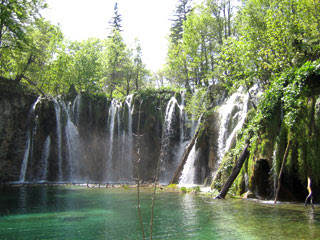
Plitvice Lakes are one of the most beautiful natural sights in Europe. In the year 1979 UNESCO has declared it with all rights as the World's natural inheritance. National Park Plitvice Lakes with total surface area of 266 km2 comprises 16 terrace-formed lakes, which are mutually connected with waterfalls and cascades. First lake lies on 636 meter altitude, while the last one, 8 km further to the South lies on 133 meters. Largest depth of the lakes is 46 meters, and natural phenomenon of Plitvice is transparency of lake water, which reaches 8 meter deep.
The Lakes are divided into two groups: Upper Lakes (12) surrounded by a huge forest are larger and more quiet while the Lower Lakes (4) lie under 70 meter high cliffs, and are surrounded by low vegetation. Plitvice Lakes were pronounced a National Park in 1949. For its beauty they are talked of as one of the most beautiful natural sights in Europe. In the year 1979 UNESCO has declared it with all rights as the World's natural inheritance. Today Plitvice are the most visited Croatian tourist destination, and the number of guests exceeds even town of Dubrovnik.
The Lakes are situated in the area where flat Croatia enters karst mountain area, and where traffic directions from the North lower towards the coastal areas of Croatia. For this reason Plitvice Lakes are an excellent place for a rest and stop on the way to sea, good lunch or even overnight stay. Distance from Zagreb is 140 km in direction of South.
Plitvice Lakes offer their visitors kilometers of arranged walking paths which in most cases means wooden bridges built over lake surface and serpentine-like connecting one shore to the other.
Since forest vegetation in warmer part of the year is extremely lush due to influence of coastal climate, and continental geographic position supplies Plitvice with plenty of snow in the winter, the National Park is well visited in all seasons of a year. Lakes There are forest areas within the Park, which, due to their virgin wood features, were proclaimed to be special reservates (e.g. Corkova uvala). There is snow on Plitvice from November to March, which is favorable for lovers of cross-country skiing. The Lakes surfaces freeze in December and January.
In the summer water temperature in the largest Lakes, Proscansko and Kozjak is around 24°C, which makes it suitable for bathing. There are altogether 20 caves in to rocks near the Lakes the famous of which are Golubinjača (Pidgeon cave), Mračnjača (Dark cave), Velika pećina (Great cave) and Šupljara (Empty cave).
You can make a tour with a tourist train and boat beside walking. Depending on your choice of visit program (there are six itineraries offered by the management of the National Park), you will need 3 to 6 hours for an organized tour. Guests who wish to stay on Plitvice can find accommodation in hotels Jezero, Plitvice, and Bellevue which are situated in narrow zone of National Park. The accommodation can, beside in hotels, also be found in private houses.
Plitvice Lakes are best known for its legendary film Winnetou based on classic work by Carl May. Original title of the film from 1960-ies, "Treasure of Silver Lake" (Der Schatz im Silbersee) is filmed on Plitvice Lakes starring actors such as Lex Barker, Herbert Lom and Pierre Brice.

Kornati islands Croatia

Should you ever decide to visit the Kornati islands, you may at first be stunned by the contrast of sharp white rocks and the calming blueness of the sea, which hides endless secrets of its inhabitants. However once you became familiar with this natural phenomenon, you would realize that what you are dealing with is a fantastic example of two extremes complementing each other. The coming together of these extremities has created this Croatian national park and will take your breath away.


Kornati Croatian islands

This is how journalist Jon Bowermaster of National Geographic Adventure, embarked on a journey by kayak from Zadar to Dubrovnik and was amazed by the Kornati islands: “the beauty is ragged and rough, cultivated but untamed”. What was it that impressed him so much? Perhaps it was the famous Kornati “crowns” that are the most well known phenomenon of the park.

The “crowns” refer to the beautiful white vertical cliffs that face the open sea. They are witness to, but also the best result of, a long geological process that patiently and carefully shaped them.

The common shag, the gray hawk and the common swift are only some of the inhabitants that have made the crowns their home. You can enjoy the crowns from afar because climbing is not permitted here. Naturally, the crowns stretch under the sea as well which opens up an entirely new dimension to bear witness to if you happen to be a deep-sea diver.

Seven diving zones invite you to discover the underwater thrill. All you have to do is follow the lead of one of the local diving centers that are sure to point you in the right direction. For those of you that are not into diving, the Kornati elevated lookout points are definitely the alternative so head towards Metlina, Opat, Vrujsko, Litnji vrh or Otocevac and you will surely enjoy the view of the entire region of the national park.

Due to the fact that the terrestrial part of the park is privately owned by the inhabitants of the surrounding islands, climbing up any of the peaks requires one to be careful and considerate, which also applies to strolling on the islands. You are probably wondering if people ever lived on the Kornati islands. Take a look at the Illyrian ruins and tumulus, the oldest structures on the islands, situated on high ground on the islands of Kornat and Zut. As a pledge of the Byzantine period we are left with Turet, a fortress on the island of Korant, believed to have been built in the 6th century. Its purpose was to protect and follow ships sailing in what was then the uncertain Adriatic Sea.

A visit to the Solana in Lavsa could also prove to be interesting, in other words its sunken remains, but also a small island called Vela Panitula, where the Venetian fortalice was built during the beginning of the 16th century. It was in this fortalice that Kornati fisherman left money for fish tax and the hard lifestyle of a fisherman forced them to build settlements on the nearby island of Piskera. They lived on this island only during the “summer darkness” when there was no moon visible in the sky, which is also the time when it is easiest to catch blue fish. With the fall of the Venetian Republic the tradition of temporarily inhabiting small islands disappeared and as such there are only rare traces of former settlements.

A trip to the Kornati islands will definitely be a significant piece to the puzzle of your visit to Croatia, because strolling on the islands will be an interesting lapse in time. A view of the Kornati beauties will convince you that Mother Nature truly thought of everything. Take the time to familiarize yourself with the beauty that the Kornati islands have to offer. Who knows, perhaps this somewhat savage form of beauty will encourage you to rediscover values within yourself that have long been forgotten.

Saturday, July 14, 2007

The Uffizi Gallery Florence

The Uffizi Gallery in Florence

The Uffizi Gallery is housed in the Palazzo degli Uffizi, a palazzo in Florence, Italy, housing one of the oldest and most famous art museums in the world. It is located at 43°46′7.1″N, 11°15′18.77″E.
Building of the palace was begun by Giorgio Vasari in 1560 for Cosimo I de' Medici as the offices for the Florentine magistrates — hence the name "uffizi" ("offices"). Construction was continued to Vasari's design by Alfonso Parigi and Bernardo Buontalenti and ended in 1581. The cortile is so long and narrow, and open to the Arno River at its far end through a Doric screen that articulates the space without blocking it, that architectural historians treat it as the first regularized streetscape of Europe. Vasari, a painter as well as architect, emphasized the perspective length by the matching facades' continuous roof cornices, and unbroken cornices between storeys and the three continuous steps on which the palace-fronts stand.
The Palazzo degli Uffizi brought together under one roof the administrative offices, the Tribunal and the state archive (Archivio di Stato). The project that was planned by Cosimo I, Grand Duke of Tuscany to arrange that prime works of art in the Medici collections on the piano nobile was effected by Francesco I, who commissioned from Buontalenti the famous Tribuna degli Uffizi that united a selection of the outstanding masterpieces in the collection in an ensemble that was a star attraction of the Grand Tour.
Over the years, further parts of the palace evolved into a display place for many of the paintings and sculpture collected by the Medici family or commissioned by them. After the house of Medici was extinguished, the art treasures remained in Florence by terms of the famous Patto di famiglia negotiated by Anna Maria Lodovica, the last Medici heiress; it formed one of the first modern museums. The gallery had been open to visitors by request since the sixteenth century, and in 1765 it was officially opened to the public.
Because of its huge collection, some of its works have in the past been transferred to other museums in Florence — for example, some famous statues, to the Bargello. A project is currently underway to expand the museum's exhibition space by 2006 from some 6,000 metres (64,000 feets) to almost 13,000 metres (139,000 feets), allowing public viewing of many artworks that have usually been in storage.
In 1993, a car bomb exploded in Via dei Georgofili and damaged parts of the palace, killing five people. The most severe damage was to the Niobe room, the classical sculptures and neoclassical interior of which have been restored, although its frescoes were beyond repair. The cause has never been cleared up, although some suspect the Mafia.
Today the Uffizi is one of the most popular tourist attractions of Florence. In high season (particularly in July), waiting times can be up to five hours. Visitors who reserve a ticket in advance have a substantially shorter wait.
The museum plays a significant role in the film Hannibal, being the place where Hannibal Lecter has stowed himself after escaping from prison (in The Silence of the Lambs), and where he murders two more of his victims. The Uffizi also may be referenced in the chorus of the song "You Enjoy Myself" by Phish, although the band has famously neither confirmed nor denied the exact lines of the song's chorus.

Thursday, July 12, 2007

How to get in Cairo

Cairo train station

Cairo is the capital of Egypt and, with a total population in excess of 16 million people, one of the largest cities in both Africa and the Middle East (which regions it conveniently straddles) - it is also the 13th largest city in the world. Situated on the River Nile, Cairo is famous for its own history - preserved in the fabulous medieval Islamic city and in Old Cairo - and for the ancient, Pharaonic history of the country it represents. No trip to Cairo would be complete, for example, without a visit to the Giza Pyramids, to nearby Saqqara, or to the Egyptian Museum in the center of town. Though firmly attached to the past, Cairo is also home to a vibrant modern society.
Cairo International Airport (IATA: CAI), is well served by Egyptair, the national carrier, and others such as British Airways, Air France, [KLM], Singapore Airlines and Lufthansa. Egypt Air now lands and departs from the domestic terminal, even for international flights.
Getting to downtown Cairo can be a pain. 40 LE is a good price by taxi, and refuse to pay the "ticket" (ie, airport toll) for the driver. For the adventurous, catch a public bus to Midan Tah Rir or Midan Ramses. Walk 5 minutes out of the terminal to the big undercover bus station, and ask a local, but don't catch the notorious green buses. Rides are just under 2 LE. It takes around 1 - 1.5 hours to reach downtown.
Cairo's main railway station - Ramses Station (Mahattat Ramses) - is located on Midan Ramses. Trains run to Cairo from most other regions and cities within Egypt.

Alexandria are served by a large number of departures throug the day. Among the best trains are the Espani which has a morning service from Cairo at 9am. The Espani and Turbobin are the best services, driving non-stop to Alexandria and taking 2 hours and 40 min. The next best service is al-fransawi, which stops at the major Delta cities on the road. Buy tickets one day in advance to be
Going to Upper Egypt, Luxor and Aswan, the Sleeping Trainleave Cairo 8 pm and arriving in Luxor 5.05 am and Aswan 8.15 am. Check the website for more departures, including one three days a week from Alexandria. It's relatively expensive at 60 USD for a bed in a double-person cabin one way. Tickets are bought at the office to your left as you enter the train station from the Metro and taxi station. The tickets are payable in US dollars only (there are no exchange offices at the train station itself).
Going to Upper Egypt, the alternative to the expensive sleeper (or flying) is the ordinary trains. One of these departs at 00.30 to Luxor and Aswan and is supposed to take 10 hours to Luxor and 13 hours to Aswan.
Trains also depart to the canal cities, but buses are much faster.
For those unfamiliar with Cairo traffic, one shouldn't expect to drive. The traffic is, at the least, overwhelming for the common traveler. Road signs, lanes, right-of-ways, etc. are not adhered to. The driving has a consistency, but not in any official way. Parking houses or official parking spots are rare, but many places people work to look after parked cars. A small tip is expected for this service.
Getting in and out of Cairo, the roads to and from Fayoum and the destert cities in the south-west and Alexandria, Delta and Marsa Matrouh in the north-west are through the Giza and pyramids area, the road to Beni Suueif and Upper Egypt (Aswan, Luxor) is in the south, after Maadi and Helwan. North from Heliopolis are the road to the canal cities (Port Said, Ismailiyya, Suez) and Sinai. Ein al-Sukhn and Hurghada is best reached by the tolled road after New Cairo City.
Buses arrive to Cairo from virtually all over the country. The two main destinations are Midan Ramsis and Turgoman, but vechiles also sometimes stop at other destinations, notably abbasiya. From Midan Ramses and Turgoman it's a quick 5 EP taxi cab ride to downtown, 7-10 EP to Zamalek.
The Turgoman has, from 2007, been renovated into a new, modern indoor station, close to the older one
From Turgoman, hourly services run to the canal cities (2 hrs) and Sharm al-Sheikh. To Sharm, the East Delta is taking approximately 8 hrs. The Superjet is faster, driving non-stop without a break in approximately 6 hrs. Three of the East Delta services continue to Dahab. Fares for the East Delta is approximately 80 EP for foreigners.
Services also go to Taba and Nuweiba, leaving three times daily (including one night services) with prices comparable with the services to Sharm. It takes 6 hrs all the way to Nuweiba.
To the canal cities, Port Said, Ismailiya and Suez, buses go all the time from Turgoman station, costing 20-30 EP. The travel to all destinations takes a little bit more than two hours.
Uncomfortable, but cheap, microbuses leave from Cairo to a large number of destinations. The main garages are Midan Ramsis and al-Marg metro station (for the north-east and Sinai). They are faster and might as such be an option for shorter trips, but have a terrible toll of acccidents. There are also other places these buses leave from depending on your destination, ask locals. Be aware that at least for Sinai, foreigners are prohibted to use the microbus system.

Tuesday, July 10, 2007

British Airways London Eye

British Airways London Eye

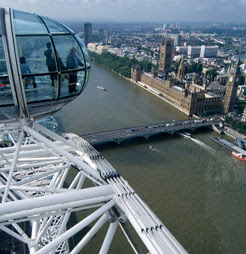
The British Airways London Eye is the world's tallest observation wheel at 135m high. Located on the banks of the River Thames it offers unrivalled views over London.

Since opening at the turn of the century, the London Eye has become an iconic landmark, with a status that can be compared to Tower Bridge, Big Ben, Eros and the Tower of London. It has been used as a backdrop in countless films and for innumerable TV programmes. A source of pride for the whole country as well as the capital, the London Eye is the most distinctive addition this century to the world's greatest city, loved by Britons and tourists alike.

In fact, in its short life, it has become the most popular paid for UK visitor attraction, visited by over 3.5 million people a year (an average of 10,000 a day). A breathtaking feat of design and engineering, passengers in the London Eye's capsules can see up to 40 kilometres in all directions, in complete comfort and safety.

But there's much, much more to the London Eye than its views and its engineering. It plays an integral role in the community, has become something of a gateway or a symbol for London and offers a unique venue for corporate events and entertainment.
The British Airways London Eye is operated by the London Eye Company Limited, a Merlin Entertainments Group Company.

Intercontinental Hotel in Amsterdam

AMSTEL INTER-CONTINENTAL

PROFESSOR TULPPLEIN 1
AMSTERDAM, 1018 GX
NETHERLANDS

Property Type: Hotel
Guest Rooms: 83
Directions: In the City Centre, on the Banks of the Amstel River.
From city center:
Direction: It is city center
Distance: 0 - 15 minutes
Area Airport: Amsterdam Schiphol International (AMS) - 20 km
24 Hour Front Desk
Express Check-out
Room Service
Indoor Pool
Business Center Facilities
Laundry/Valet Service
Safe Deposit Box
Tour Desk/Concierge
Mini Bar Rooms Available
Air Conditioned Rooms
Voice Mail in Rooms
Cable Television
Video Tape Player
Barber/Beauty Shop on site
Bar/Lounge on site
Restaurant on site
Shops on site
Hot Tub on site
Fitness Center on site
Other Features: Fax, Tanning Bed & Massage, Secretarial Services

Need A Room?

Monday, July 9, 2007

Hurghada Egypt

Hurghada Egypt

Hurghada was once a fairly small and unimposing fishing village, located next to the Red Sea and boasting a number of superb beaches. Today, the resort of Hurghada is almost unrecognisable from its past life and has grown to become probably the most visited tourist destination in the whole of Egypt, with in excess of 100 different hotels, many of which line the shoreline.
Famous for its superb diving opportunities, Hurghada is especially appealing to those with little experience of scuba diving, who come to marvel at the underwater reefs and awesome marine life. Tourism is now a huge part of Hurghada and each year, many tourists choose to combine their holiday here with visits to other prominent locations along the Nile Valley, including the relatively nearby city of Luxor.
Hurghada's foremost tourist attractions include its beautiful beaches, which have long been a major drawcard in the town and boasting white, fine sand and many spectacular coastal views, with many beaches being located next to hotels. Other top tourist attractions in Hurghada include the vibrant and rather colourful local market of Bazaar in Ed-Dahar, the marine life at the Red Sea Aquarium, and also the many underwater attractions and breathtaking coral reefs at the Giftun Islands. More information on Hurghada Tourist Attractions.
Around the tourist resort of Hurghada you may be surprised to find a number of rather historical landmarks. Amongst the most notable are the monasteries of both St. Anthony and St. Paul, although the Roman site of Mons Claudianus is particularly impressive and was in use for more than 200 years. Also of interest is Hurghada's Anfish Mountain, which provides some of the best views of the Red Sea, the town and beyond. More information on Hurghada Landmarks.
Several good museums and pleasant art galleries exist in the town of Hurghada. The best offerings include the Marine Biology Museum - complete with many underwater sights, biology station and information about local marine life, the National Museum - a new addition to the city's tourist attractions and showcasing many treasures found in the Eastern Desert; and the Café del Mar - where paintings are displayed in restaurant surroundings. More information on Hurghada Museums and Art Galleries.
Close to Hurghada you will find many of Egypt's top tourist attractions and most impressive resorts. A particularly favourite is Sharm el Sheikh, which lies alongside the Gulf of Aqaba and is famous for its scuba diving and sandy beaches, while on the south-western side of Hurghada, the provincial capital of Qena contains a particularly impressive temple complex. Also within reach of Hurghada, the city of Luxor is without equal and full of awe-inspiring monuments, such as the Valley of the Kings. More information on Hurghada Attractions Nearby.

Wednesday, July 4, 2007

Lepenski Vir

lepenski vir idol

Lepenski vir, a unique prehistoric discovery, was brought to light about twenty years ago.

The most important finds in the well laid-out settlement are a number of monumental stone sculptures made some six to seven thousand years ago.

Nothing comparable has ever been unearthed in relation to such early prehistoric periods in the Balkans and the Danube basin.

Particulary valuable to the study of the history of culture and art in the prehistoric Europe are the worked round boulders and marked slabs also found there.

In last few years in the Iron Gate area a separate prehistoric culture was discovered and researched — the culture of Lepenski Vir — which chronologically and culturally links the culture of the Late Paleolithic of this area with the oldest Neolithic culture of the type Starcevo—Körös—Kris. Beside varied and rich archeological finds — the remains of dwelling places, stone sculptures, stone receptacles and altars, as well as of stone and bone industry — in the find-spots of the culture of Lepenski Vir were also discovered the graves which, by their numerousness and stratigraphical position, enable the insight into the way of burying and burial rites practiced through a long time span from about 8000 B. C. till about 5.500 B. C.

For the present, nine settlements of the Lepenski Vir culture are known, four of them on the right bank of the Danube (Lepenski Vir, Vlasac, Hajducka Vodenica, Padina) and five on the left bank (Veterani, Terrasse, Icoana, Razvrata, Ostrovul Banului, Schela Cladovei). While some of these settlements have been investigated as a whole or for the most part (Lepenski Vir, Vlasac, Padina, Schela Cladovei), in the others were carried out only smaller sounding excavations. However, without regard to the degree of investigation of some settlements, it is of importance to note that the data concerning the graves found in them tune into each other, i.e. that they point to the same ways of burying and the same burial rites. The most abundant data in respect of the way of burying and burial rites give the graves from Vlasac, Lepenski Vir and Schela Cladovei. At Vlasac were found 84 graves (110 dead), at Lepenski Vir 82 and at Schela Cladovei about 20.

On the basis of vertical stratigraphy and archeological material, the culture of Lepenski Vir has been divided into two phases: the earlier, represented by the levels Vlasac Ia, b, Proto-Lepenski Vir and Lepenski Vir Ia, b, and the later phase, which includes the settlements Icoana, Schela Cladovei, Vlasac II—III, Lepenski Vir Ic-e, Lepenski Vir II, Padina and Hajducka Vodenica. In both phases the dead were buried within the settlements. However, by time, the way of burying and of burial rites changed. The graves, deriving from the level which represents the earliest phase of the culture of Lepenski Vir show that from the very beginning of this culture the dead were buried in various ways, i.e. that complicated burial rites were practiced...

Sunday, July 1, 2007

Keltic Lodge Resort and Spa

Keltic Lodge Resort and Spa

Another Nova Scotia beautiful spa. Keltic Lodge Resort and Spa .
Surround yourself with the rugged glory of Cape Breton. High on a cliff, overlooking the Atlantic Ocean, Keltic Lodge commands a view like no other and beckons you to relax and enjoy the splendor of the Highlands.

A view of majestic Cape Smokey rising out of the sea greets your arrival at Keltic Lodge. Whether you stay at the Main Lodge, the Inn at Keltic or one of our cozy two - or four-bedroom cottages (each with its own fireplace), your comfort is assured.

Now that you've made good your highland escape, there are so many ways to fill the day. Tour the world-famous Cabot Trail. Hike along wilderness trails that wend through centuries-old forests. Take a boat cruise on the ocean and watch for whales. Play a game of tennis or enjoy the sun, sand and surf of nearby Ingonish Beach. Or plunge into our heated, outdoor pool.

Nearby, the Highlands Links golf course - ranked by Golf Magazine as Canada's Top Public Course and 64th in the world, challenges you to 18 championship holes. A course rich in the Scottish tradition, restored to Stanley Thompson's magnificent original design.

A romantic, candlelight dinner in our Purple Thistle Dining Room is the perfect end to the perfect day. Here, seafood delicacies (the Chef's speciality) and other gourmet delights are served, overlooking the Atlantic Ocean. The Highland Sitting Room features nightly entertainment, and you can try the Atlantic Restaurant for a quick snack or hearty informal meals.

Escape to Keltic Lodge where our natural beauty and gracious ways will lure you here time and again.

Digby Pines Spa - Nova Scotia

Digby Pines Spa

Digby Pines Golf Resort and Spa has been welcoming guests to this Norman- Style Chateau overlooking the beautiful Annapolis Basin since 1929. The Chateau features 84 well appointed rooms and suites. For a more intimate, secluded setting choose from among the 30 one, two and three bedroom cottages nestled around the spacious grounds. Each has its own cozy living room with a fireplace and verandah.

Relaxing is easy - especially when you're surrounded by such breathtaking beauty. Spend an afternoon by our heated, outdoor pool. Walk or run the wooded hiking trails. There's tennis, lawn croquet, shuffleboard and a full fitness centre. Or try our par 71, 18 hole picturesque golf course, one of Sir Stanley Thompson's masterpieces.

Nearby, you'll find whale-watching cruises on the Bay of Fundy and some of the country's most historic sites. Visit the Port Royal habitation, the French settlement that gave birth to the New World of Canada. And drop into Canada's first National Historic Park, Fort Anne in Annapolis Royal.

For a true taste of dining luxury, experience the award winning cuisine of our famed Annapolis Room. Casual meals and snacks are served on the Verandah overlooking the basin and at the 19th Hole offering a panaoramic view of our prized golf course. Or relax at the poolside patio and enjoy a cool refreshment or a delicious ice cream treat.

For romance, fun or just a much needed rest, make us your destination. Digby Pines Golf Resort and Spa. Old- world elegance. World- class cuisine, In The Classic Manner.

Wednesday, June 27, 2007

Top beaches for romance travel

Hawaii romantic travel beach

Travel Channel made a list of The best beaches for romance vacation. In fact, they made 2 top lists, and there they are:

Top 12 U.S. Beaches for romance

Cannon Beach, Ore.
Cape May, N.J.
East Hampton, N.Y.
The Mauna Kea, Hawaii
Poipu Beach, Hawaii
Santa Barbara, California
Shi Shi Beach, Washington
Siesta Key, Fla.
Southampton, N.Y.
St. John, U.S. Virgin Islands
Trunk Bay, St. John, U.S. Virgin Islands
Wailea, Hawaii

Top 13 World romantic Beaches

Anse Source d'Argent, Seychelles
Clifton Beach, South Africa
Crete, Greece
Culebra Island, Puerto Rico
Datai Beach, Langkawi, Malaysia
Grand Cul-de-Sac, St. Bart's
Larvotto Beach, Monaco
The Maldives Islands
Maroma Beach, Mexico
Natadola Beach, Fiji
Negril, Jamaica
Ofu Beach, American Samoa
Pink Sands Beach, Bahamas

Romantic beach guide on Travel Channel


AddThis Social Bookmark Button

Monday, June 25, 2007

Cadiz - Mediterranean Spain tourism

The closest airport is Jerez de la Frontera, approx 30 minutes by car or taxi (fixed price €46), 1 hour by direct bus. There are several daily flights to Madrid and Barcelona (Iberia, Spanair, Vueling). Ryanair fly daily to London Stansted and Frankfurt Hahn. Other operators fly scheduled, charter, or seasonal flights. The nearest major airports are in Sevilla (hour by car, 2 hours by bus or train) and Malaga (2-3 hours by car or bus).
Buses run to and from Seville, Jerez, Algeciras, etc. A ticket from Jerez to Cadiz is about 10 euro. For Jerez-Cádiz timetables see Consorcio de Transportes Bahia de Cadiz.
Frequent trains run to Jerez and about hourly to Seville. A very convenient way to come in from Madrid is with the Talgo train that runs twice a days covering the distance in about 5 hours. See RENFE for timetables.
From Madrid, Cordoba and Seville you can use the A4, from Barcelona N340. A taxi ride from Jerez de la Frontera to Cadiz costs about 50 euros.
A modern monument of Cadiz are the huge pylons of the powerline crossing the bay of Cadiz. These 150 metre high pylons are lattice towers with cylindrical cross section.
Everyone should visit the Cathedral in the old town and climb to the top of the cupula for a nice view of the entire city.
The Torre Tavira, near the Central Market (Mercado de Abastos) is a 19th century camara oscura in perfect working order. Located in one of the towers originally used by merchants to watch out for their ships returning home from the Americas, it provides a birds-eye view of the old part of town.
Get to Cadiz for Carnaval, usually in February, one of the oldest and best in Spain.
Semana Santa (Easter or Holy Week) is less formal than in Sevilla, and probably more authentic and emotive an experience for that.
Enjoy the best sunset in Spain on 'la playa caleta' on the southern end of old Cadiz. The main beaches (Santa Maria Del Mar, Victoria, and Cortadura) start at the edge of the old town, continue all along the edge of the new town, and on alongside the road to San Fernando. In total some 10 km of the widest, cleanest beaches you will find in Europe, with safe bathing from around May to October. The summer heat is usually tempered by an Atlantic breeze, although on days when the Levante blows beware of flying sand.
In Cadiz you will find some of the best and freshest fish and shellfish in the world. They are best eaten as simply cooked as possible: plain boiled shellfish (in varying sizes from tiny prawns up to lobsters), grilled or baked whole fish such as lubina (bass) or dorada (bream), or deep fried with a light flour coating (especially puntillitas (baby squid) and boquerones (anchovies).
Fino, a bone dry sherry (or Jerez), or manzanilla, a similar wine from Sanlucar de Barrameda, is the perfect aperitif with olives or a prawn or two. Drinking more than a couple of glasses may spoil your focus on the rest of the meal. The best local white wine (and one of the most popular in Spain) is Barbadillo, made from the same grape but considerably lighter.
Casa Caracol - Inexpensive and quite relaxed hostel on the old part of Cádiz. Visit www.caracolcasa.com for prices and reservations.
Hostal La Cantarera is an excellent hostel for what it costs, with clean, luxurious rooms and friendly management, located in the old town.

Friday, June 22, 2007

Rhodes

Rhodes is the largest Greek island of the Dodecanese group of the South Aegean Islands of Greece. It is known for the Colossus, one of the seven wonders of the ancient world, which was sadly destroyed.

Rhodes has everything from beautiful beaches to a lush, green interior, a bustling capital and one of the best sunshine records in Greece. The rock-rose is so prolific here that it has been named the 'Island of Roses' and while the northern coast is renowned for its lively tourist resorts the south offeres tranquil beaches and a slower, more simple pace of life.

Cities on Rhodes


* Rhodes city - The biggest city on the island and seat of the local government
* Lindos - Small village with an old acropolis. Located around a small hill. No cars are allowed in the large areas of the town.
* Haraki - Small former fishing village located next to Lindos.
* Pefkos - A smaller tourist resourt close to Lindos. Originally started as a small collection of farms and private residences, but has grown into a town in its own right.
* Faliraki - Rhodes' "action resort". Go there to party, everything else is better somewhere else.
* Kalithea - snorkeling and resort hotels.
* Lardos
* Gennadi
* Afandou - One of the big villages on the island. The golf course of Rhodes is situated in this area along with a long beach
* Ixia - West coast resort, close to Rhodes city
* Theologos - A traditional village

Rhodes info


The local tourist information office for the Dodecanese Islands is located in Rhodes city at Makariou & Papagou Corner (opposite the New Market). Telephone 22410 44335-6, Fax 22410 26955.

Beaches on Rhodes


There is a good variety of beaches on Rhodes. The east side of the island has almost continuous sandy beaches with calm waters. Beaches on the west are mostly more stony. The wind mostly comes in from the west and also the sea tends to be somewhat rougher to the west so that side of the island is better suited to surfing or kite boarding.

* Rhodes Town.
* Lindos. The stunningly beautiful town beach on the bay. Very trendy, so wear your thong bikini here if you want to fit in.
Lindos Beach, as seen from Lindos village
* Kalithea. Just north of Faliraki, this was originally an Italian built spa. It is very pleasant spot but can be crowded. Currently building work is ongoing to build what looks like it will be a modern spa adjacent to the original buildings. A number of separate beaches, each seemingly with their own taverna lie just south of the spa.
* Faliraki. A long sandy beach with plenty of tavernas to choose from. There is also no shortage of people to rent jet skis from or to organise other activities. At the southern end, there is a quiter, more rocky beach but the sea there is inconveniently shallow for swimmers. There is also a nudist beach a little further South.
* Ladiko Beach (Anthony Quinn Bay). This is a very scenic spot. On one side of the bay is a relatively small beach. The other side is rocky but a man made platform provides further space for sunbathing and access to the sea.
* Afandou Beach
Afandou Beach
Afandou Beach
* Kolymbia Beach.
* Tsambika Beach
* Gennadi Beach
* Agia Marina Beach


AddThis Social Bookmark Button